Memorable Stories From Cheltenham and Its Theatre of Dreams
 by Roy Brindley 20.07.2026
There is more to the Cheltenham Festival than just off-course gambling. Despite an attendance cap, the annual spectacle attracted over 225,000 racegoers in 2026, and the meeting is nicknamed the “theatre of dreams.” Join us as we revisit some of the forgotten headline moments that have helped shape the story of the Cheltenham Festival.
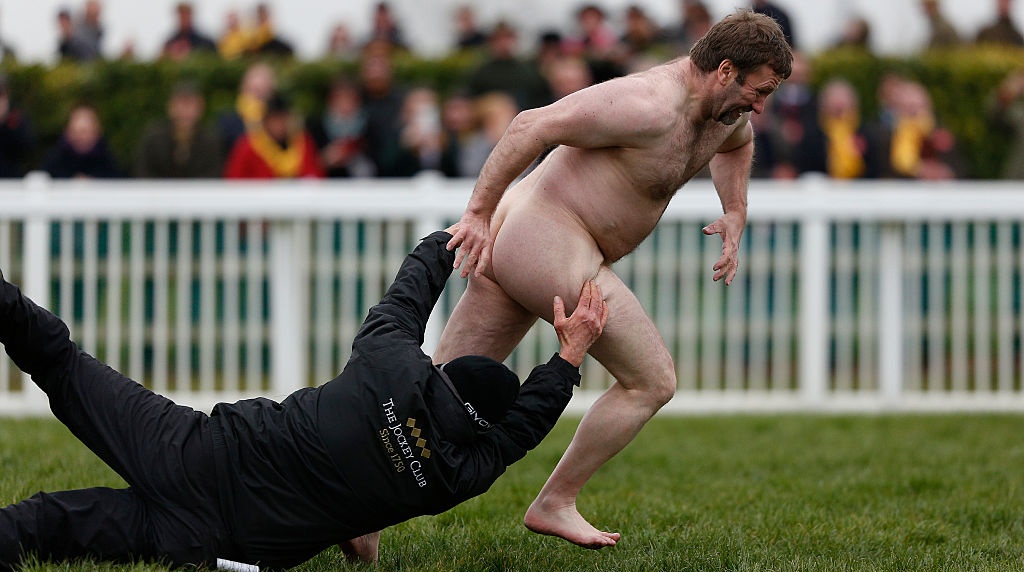
Company director Paul Cooke landed himself in hot water after he decided to run naked up Cheltenham’s home straight in 2016. © Getty Images
Racing for a Piece of Festival History
In 2022, for the first time, Entain, owners of Ladbrokes and Coral bookmakers, declared that all 28 Cheltenham Festival races featured in the top 35 biggest betting races of the year. Unsurprisingly, the company labelled the March Festival as “the biggest and most important week of the year for bookmakers and their customers.”
Beyond betting, Cheltenham is where owners, trainers, and jockeys aspire to etch their names into sporting history. Recent unforgettable moments include Rachael Blackmore’s success in the 2022 Gold Cup aboard A Plus Tard. The first female jockey to win the National Hunt racing’s biggest prize, her success was described as “the ultimate breakthrough.”
Cheltenham’s finest winners and most glorious moments are easy to recall. The Festival’s history is also filled with laughter, extraordinary incidents, heartbreak, and some tragedy. Here are just a few memorable moments.
The Streaker That Lost It All
On April 20, 1974, during halftime of a rugby union match between England and France, a 25-year-old Australian stockbroker, Michael O’Brien, landed a £10 bet between friends for running naked across Twickenham Stadium’s pitch.
Michael O’Brien, the first known streaker at a sporting event. He streaked in front of 53,000 people at a 1974 England vs France Rugby match pic.twitter.com/mhsryu6kJy
— Sports & Betting History by BestBettingSites (@BettingSitesCom) September 26, 2016
The £10 he won for his alcohol fuelled prank was later used to pay the £10 fine imposed by Richmond Magistrates for ‘insulting behaviour’. O’Brien’s prank is now acknowledged as the first modern sports streak. Little did anyone know at the time that his high-spirited frivolity would start a craze.
For decades, no sport was safe. From Wimbledon to the Olympic Games, streaking became part and parcel of the proceedings. Horse racing had appeared immune until Cheltenham Gold Cup day 2016, when an individual named Paul Cooke decided to run naked up Cheltenham’s home straight during the Foxhunter Chase.
One month later, the 47-year-old company director from Coventry was ordered to complete 60 hours of unpaid work, pay an £85 fine towards prosecution costs, and a £60 victim surcharge, by Cheltenham’s Magistrates Court.
Cooke’s moment in the sun (and the Star and the News of the World!) soon faded, but in January 2019, he caught the newspapers’ attention again when it emerged he was the co-owner of Economy Energy, a company that had gone bust amid complaints that it had been withholding an estimated £30 million from its 230,000 customers.
The 2020 COVID Festival Created National Headlines
Over four days, from March 10 to 13 2020, more than 251,000 racegoers (125,000 individuals, 20,000 from Ireland) poured into Cheltenham’s Prestbury Park Racecourse for the annual Festival despite the news being dominated by a new and highly contagious disease called COVID-19.
The decision to let the event go ahead, or not to cancel the meeting before day three when the number of reported cases in the UK had doubled in two days, with no social distancing, masks or other precautions, was controversial at the time.
It would later become a massive news story, as within days, racegoers began falling ill. Hospitals in Gloucestershire and neighbouring areas saw spikes, and a former government chief scientific adviser called it “the best possible way to accelerate the spread of the virus.”
The Telegraph’s sports writer, Alan Tyers, who was at the Festival, said: “People were crammed six deep at the bars, there was drunken shouting and singing. If you were going to design a virus dispersion hub, you could do worse than the indoor bits of a packed racecourse.”
Three days after the 2020 Festival ended, a report declared that, without major intervention, around 500,000 people would die in Britain due to COVID-19. Days later, the Prime Minister had closed all pubs and restaurants, and within a week, a ‘stay-at-home ‘ instruction had been issued.
Snap Away and Break a Leg
One person who needed immediate medical attention, leaving Cheltenham in an ambulance, is Racing Post photographer Patrick McCann. Busily snapping the action during the Glenfarclas Handicap Chase from the inside of the course, a freaky incident saw a horse crash through the rails and flatten him.
Here is the photo that cost Patrick McCann @patrickmccannrp a broken leg yesterday at Cheltenham. Get Well Soon! pic.twitter.com/9Ic4fsnjEp
— Cheltenham Tips (@CheltenhamTips) March 12, 2015
The 2015 accident left the photographer with his leg broken in two places. After months away from work, McCann made a full recovery and enjoyed recognition for his work when receiving the Horserace Writers’ & Photographers’ Association Derby Awards Photographer of the Year prize in 2021 and 2023.
Cheltenham’s New Grandstand Served as a Hospital
Racing at Cleeve Hill, which overlooks Prestbury Park Racecourse, dates back to 1818. Although not on the same course, the current venue began racing in 1831. It was in 1902 that the present-day course came into being. 12 years later, a new grandstand had been completed for the course that was rapidly growing in stature.
In July 1914, World War I broke out, and Cheltenham Racecourse took on a new role as a Voluntary Aid Detachment (VAD) / British Red Cross auxiliary military hospital. For four-and-a-half subsequent years, wounded, sick and convalescing soldiers were treated at the course.
Originally caring for 100 soldiers – primarily Belgian troops – Cheltenham’s pop-up hospital grew significantly, eventually featuring over 200 beds with a Southam Ward built in the paddock area and grandstand balconies used for open-air treatment.
The Voluntary Aid Hospital at Cheltenham Racecourse opened its doors in October 1914 pic.twitter.com/dLukafjS4e
— Sports & Betting History by BestBettingSites (@BettingSitesCom) March 12, 2020
By the end of the war and its closure on February 28, 1919, 3,167 patients had been treated at the racecourse hospital. It is believed that only 18 soldiers failed to recover from their injuries and died there.
Hats off to a Big Race Winner
Norton’s Coin caused one of horse racing’s biggest upsets when taking the 1990 Cheltenham Gold Cup. Trained by little-known Welsh dairy farmer Sirrell Griffiths – who only had three horses in his yard – Norton’s Coin’s 100/1 SP means he is the joint-biggest priced winner in Festival history.
Victory for the small trainer with his obscurely bred horse left most people stunned. A few were elated, including the winning jockey, Graham McCourt. In his delight, while returning to the winner’s enclosure, the rider grabbed the trainer’s wig and threw it into the crowd.
In doing so, Griffiths’ hitherto well-kept secret of being bald was amusingly exposed before friends, family, racegoers and a huge television audience. In turn, it created an amusing and unforgettable Cheltenham Festival moment.
JT Paid the Ultimate Price
The Cheltenham Festival has witnessed its fair share of tragedy, none more so than in 2013 when Galaxy Rock, carrying outstanding amateur rider JT McNamara, fell at the first fence of the Fulke Walwyn Kim Muir Challenge Cup.
The Irish rider, who had ridden over 600 point-to-point winners during a glittering career, was immediately helicoptered to the hospital, where a broken neck and serious back damage were diagnosed.
Paralysed, McNamara spent the next 15 months recuperating in English hospitals before being able to return to his homeland. However, in July 2016, the then 41-year-old suffered complications and was discharged from the hospital to spend his final days with his family.
 5 Exciting Slot Games Where You Hunt for Treasure
 Try Your Luck on These 5 Popular Roulette Games
 How Your Online Casino Customer Support Experience Should Be
 Give These 5 Progressive Jackpot Slot Games a Spin Today