Online Gambling Laws in the UK – Full Overview & Expert Summary
 Written by Heath Chesters
Gambling Commission GamCare
Table of Contents
Article Summary
Written by Heath Chesters
The legal gambling age in the UK is 18 under Part 4 of the Gambling Act 2005, which includes wagering at online casinos and sports betting sites.
Under the originally published Lotteries Act 1993 and Gambling Act 2005, the minimum age for lotteries and scratchcards was 16. However, this was raised to 18 when The National Lottery (Revocation and Amendment) Regulations 2021 were published.
| Online Casinos | 18 |
| Sports Betting | 18 |
| Lotteries | 18 |
| Scratchcards | 18 |
Unlike some other countries where gambling activities vary by activity or region, the UK strictly enforces the minimum age of 18 for all gambling participants. When registering at an online casino, you may be asked to prove your age. This is verified by uploading copies of your identification documents.
“To verify proof of age with an online casino, use your passport or driving licence as both feature your date of birth. Alternatively, send a copy of your birth certificate.”
In the UK since the abolition of such taxes in 2001, online casino players and sports bettors do not pay any taxes on betting stakes or gambling winnings. Instead, gambling operators are taxed under Part 3 of the Finance Act 2014.
“Your gambling stakes and winnings are not taxable in the UK. It’s the gambling operators who must pay taxes to HM Revenue and Customs. If an online casino is trying to charge tax on your deposits or withdrawals, this is a scam. You should be aware of your rights and file a complaint if this happens.”
According to Part 3 of the Finance Act 2014, online gambling operators are subject to various taxes, including the Remote Gaming Duty (21%), General Betting Duty (15%), and Pool Betting Duty (15%). However, these percentages may also be subject to changes, depending on UK government budget announcements.
Likewise, it’s important to reiterate that all such taxes are paid by the gambling operators, not the players. This includes professional gamblers in the UK, who are not taxed directly on their gambling profits, but may be charged income taxes on earnings from sponsorships and other activities.
| Remote Gaming Duty | 21% |
| General Betting Duty | 15% |
| Pool Betting Duty | 15% |
Online slot games in Great Britain are now subject to statutory maximum stake limits. The UK Government introduced these limits following the High Stakes: Gambling Reform for the Digital Age white paper, and the UK Gambling Commission enforces them through operator licence conditions.
The limits are:
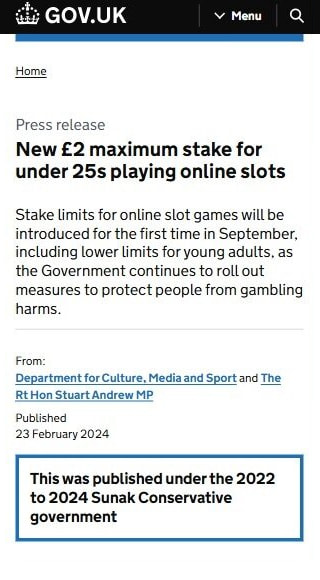
Although gambling operators did raise concerns about segregating age groups, there was overall agreement that stake limits needed to be introduced for online gaming products, and particularly online slots. However, this could lead to staking limits for other types of online casino games, and we’ll keep you updated on any changes as they come.
“Unlike land-based gaming machines, online slots previously had no statutory stake limits. Due to their ease of access, and consideration as one of the most addictive forms of gambling, the aim of the new stake limits is to reduce the risks of problem gambling.”
The UK Gambling Commission introduced a ban on using credit cards for all gambling activities. This ban includes online betting, online casino and bingo, lotteries accepting payments online or over the phone, high street and track bookmakers, plus land-based casinos, bingo halls, and arcades.
Following consultations on restricting or banning the use of credit cards, the UKGC indicated that reducing harmful gambling was a priority. This includes preventing people from using credit or creating debts to fund their gambling activities.
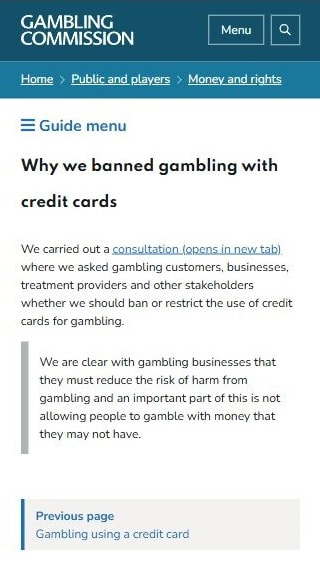
Although credit cards are banned for gambling in the UK, there are plenty of suitable alternative options. These include debit cards, bank transfers, prepaid cards, pay by phone, and e-wallets.
Important: When using e-wallets for deposits, gambling operators may ask for proof that money was not loaded from a credit card.
We have listed the alternative payment options below, indicating those which are available or unavailable to gamblers in the UK.
The UK now uses a staged approach to financial risk and vulnerability checks. These checks are intended to help licensed operators identify customers who may be at risk of gambling-related harm, while keeping the process as frictionless as possible for most players.
Light-touch financial vulnerability checks are carried out when customers reach a net-deposit threshold of £500 in net deposits over a rolling 30-day period. These checks use publicly available data and are not the same as detailed credit checks.
Separately, the UK Gambling Commission has been testing enhanced financial risk assessments with selected licensed online casinos. These pilots are designed to assess how financial risk data could be used in practice before any wider rollout.
“Financial vulnerability checks are now part of the UK’s safer gambling framework. These checks are intended to be light-touch and use publicly available data, rather than requiring most players to submit documents. Enhanced financial risk assessments are being tested separately through UKGC pilots before any wider rollout.”
Financial vulnerability checks have received pushback from some bettors and racing stakeholders, with concerns around privacy, friction, and the possible impact on recreational gambling. A petition opposing affordability checks attracted over 100,000 signatures, leading to a parliamentary debate and a government response.
However, the UKGC distinguishes between light-touch financial vulnerability checks and enhanced financial risk assessments. Vulnerability checks are designed to identify obvious signs of financial risk using publicly available data, while enhanced assessments are being tested separately with selected operators.
The enhanced financial risk assessment pilot began in 2024 and is being used to test how financial risk data could be presented to operators and built into customer interaction processes. Any wider implementation would depend on the UKGC’s findings and further regulatory decisions.
Under licensing conditions of the UKGC, gambling operators must comply with numerous laws and regulations for advertising and marketing. This includes adhering to the UK Advertising Codes, specifically the UK Code of Non-broadcast Advertising and Direct and Promotional Marketing (CAP Code 16), plus the UK Code of Broadcast Advertising (BCAP Code 17), both of which are administered by the Advertising Standards Authority.
The main focus of these gambling advertising laws and regulations includes the following points:
Applicable laws include Part 16 of Gambling Act 2005, alongside revisions and amendments published in the Gambling (Licensing and Advertising) Act 2014.
“Advertising laws and regulations are strict for good reason, ensuring that gambling ads or marketing is fair, transparent, and socially responsible. They also protect minors and vulnerable people from misleading promotions or exploitative practices.”
In order to legally offer any gambling services to customers in the United Kingdom, gambling operators, including online casinos, must hold a valid licence issued by the UK Gambling Commission.
To hold a UKGC licence, operators must adhere to all of the applicable Licence Conditions and Codes of Practice (LCCP) requirements. Failure to comply with the LCCP can result in stiff penalties and even licences being revoked.
While the LCCP is an extensive document covering all licensing regulations and requirements, here are some of the key points it establishes:
To conclude this guide page, we have listed the most important laws and acts of parliament that are relevant to gambling, so that you can access them whenever needed.
Moving into the iGaming industry was a natural progression for Heath, initially focusing on sports betting content for major brands. Following a trip to Las Vegas, that interest evolved to embrace online casinos, using his journalism background to explore and study gambling and gaming in fascinating depth.